Research

Our research

We work at the interface of bioelectronics, materials chemistry, nanotechnology and drug delivery, using electric field responsive and light responsive materials to modulate biological systems.

Electric field‑responsive sensors, actuators and transducers

Electric fields are fundamental to many biological processes, yet the development of materials capable of sensing and responding to these signals with precision remains relatively underexplored. Our research engineers quantum nanomaterials that interact with electrical signals, enabling us to probe, understand and ultimately manipulate biological systems in new ways.
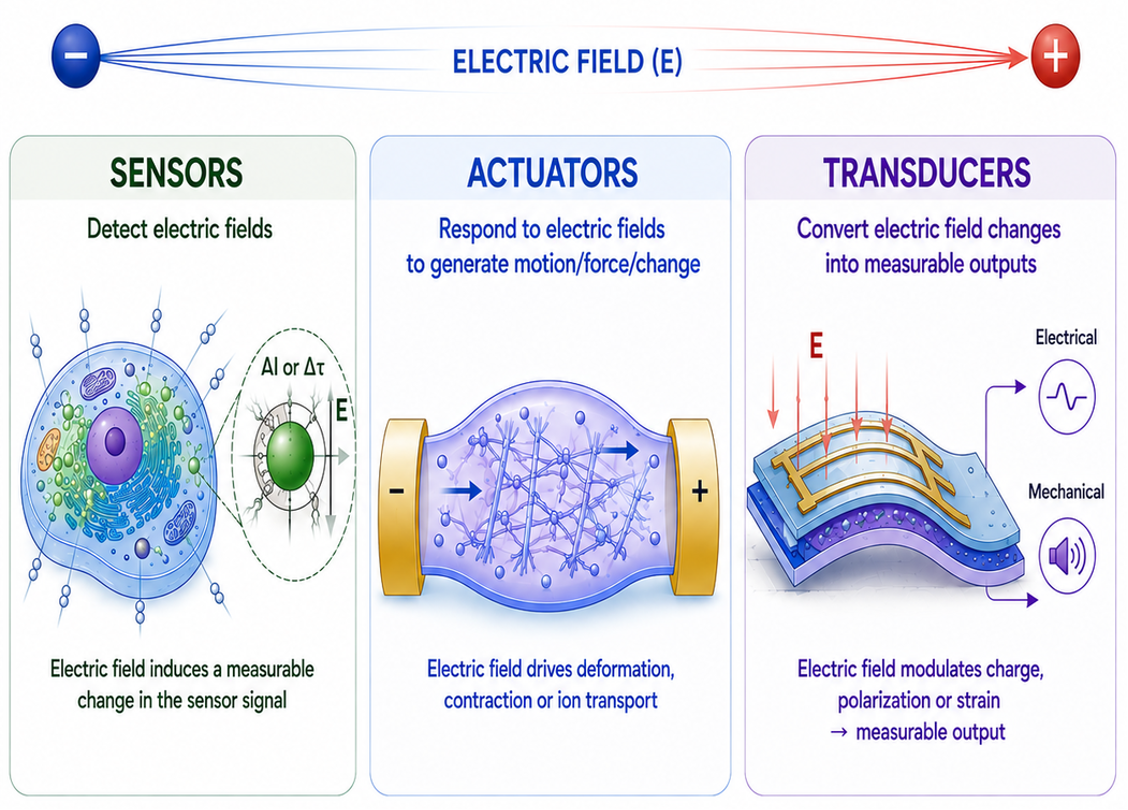
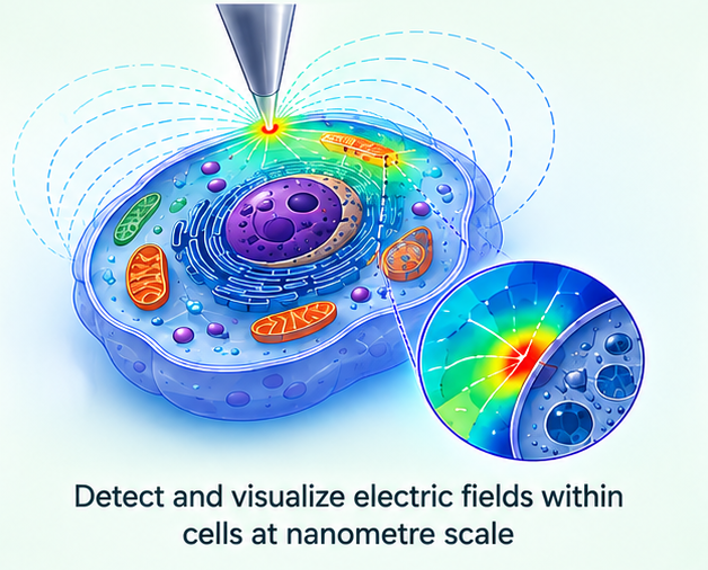
Diagram showing electric field responsive sensors, actuators and transducers
Image was created using AI.

Mapping electric fields at subcellular resolution

Understanding how electric fields are distributed within cells and their surrounding environment is important for uncovering their role in biology. We develop approaches to measure and map these fields with high spatial resolution, providing new insights into electrical phenomena at the cellular and subcellular scale. These tools could help reveal how local electric fields influence biological function.

Illustration of a probe detecting and visualising electric fields within a cell at nanometre scale
Image was created using AI.

Bioelectronics for therapeutic delivery

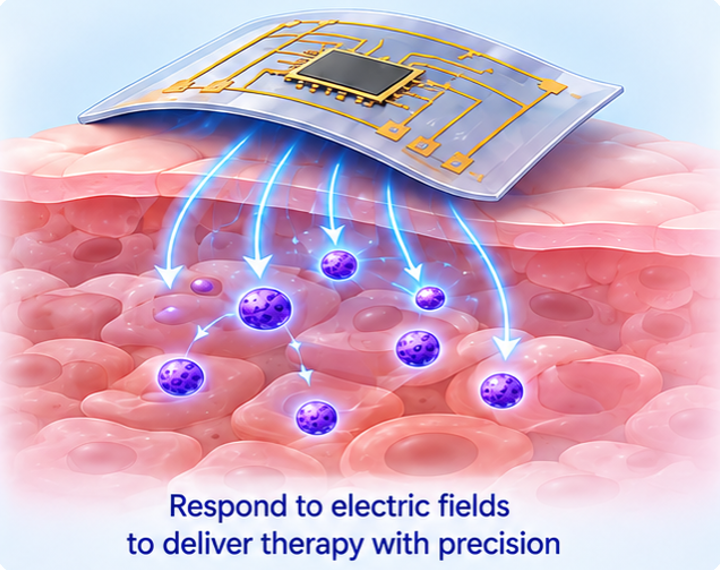
Bioelectronics offer new physical approaches to controlling therapeutic delivery with greater spatial and temporal precision than conventional strategies. Our research explores how electrical signals can guide and enhance the delivery of therapeutics in a targeted and controlled manner. We aim to develop new electric‑field‑guided treatments while improving the delivery and effectiveness of clinically approved drugs and emerging therapeutics progressing through clinical trials, potentially overcoming delivery barriers and expanding their therapeutic potential.

Illustration of a flexible bioelectronic chip delivering therapy to cells in response to electric fields
Image was created using AI.

Quantum nanomaterials for diagnostics and therapy

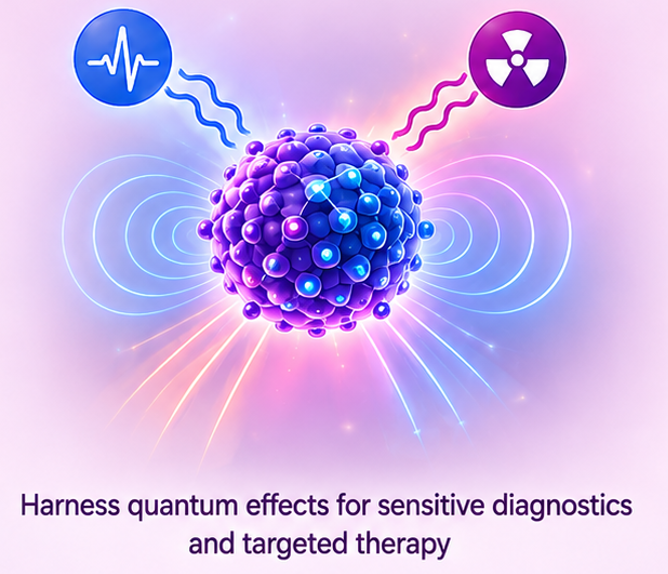
Quantum nanomaterials, including quantum dots, nanodiamonds and lanthanide doped nanomaterials with upconversion and downconversion properties, have unique optical and physical properties that make them attractive for biomedical applications. Our research explores how these materials can be engineered for applications spanning both diagnosis and therapy. By tuning their light emitting and light absorbing behaviour, we aim to develop multifunctional platforms that combine sensing, imaging and therapeutic capabilities, opening new routes to earlier disease detection and more precise, targeted treatment.

Illustration of a quantum nanomaterial harnessing quantum effects for diagnostics and targeted therapy
Image was created using AI.
Materials synthesis

1. CEM Discover 2.0 microwave reactor

A versatile platform for rapid and reproducible synthesis of advanced nanomaterials and functional materials.

  • Rapid microwave synthesis. Reactions are completed in minutes rather than hours.
  • Precise temperature control with iWave sensor technology.
  • Small scale screening through to scale up, from 200 microlitres to 100 millilitres.
  • Real time reaction monitoring and recording with an integrated camera.
  • Automated reaction handling for higher throughput synthesis.
Fluorescence microscope

2. Zeiss Axiovert 7

A newly commissioned Zeiss Axiovert 7 fluorescence microscope supports DAPI, GFP and Cy5 imaging with phase contrast, for both live and fixed cells in glass or polymer bottom dishes, including multiposition time lapse imaging over periods of up to 24 hours. The facility is now running within the lab, secured through divisional funding.

Electrical characterisation

3. Ossila four point probe conductivity meter

Used to measure the sheet resistance and electrical conductivity of thin films and coated materials, supporting the characterisation of conductive nanomaterials and coatings developed by the group.

Signal generation

4. RS Pro function generators, AC and DC

Used to generate precise alternating current and direct current electrical waveforms, supporting instrument calibration and the delivery of defined electrical stimuli in our bioelectronics experiments.

Electrical stimulation

5. Multichannel Systems STG‑5 high voltage stimulator

A compact, high precision platform for electrical stimulation.

  • Voltage and current stimulation in one device.
  • Output voltage, −50 V to +50 V at maximum, with a resolution of 250 µV.
  • High precision, with outputs from 4.5 nA to 16 mA.
  • Fast stimulation, with a rise time of less than 2 µs and a temporal resolution of 5 µs, supporting frequencies of up to 100 kHz.
  • Eight channels, with galvanic isolation to prevent crosstalk.
  • Programmable and synchronised stimulation patterns, with flexible triggering and feedback capabilities.
Custom built

6. Parallel electrode tissue culture plates

Bespoke tissue culture plates fitted with parallel electrodes, developed in house to allow controlled electrical stimulation of cells in culture.

Custom built

7. Live cell imaging with simultaneous electrical stimulation

A bespoke imaging setup that combines live cell microscopy with synchronised electrical stimulation, allowing the group to observe cellular responses to applied electric fields as they happen.